
July 27, 2026
Legal Exhibit Tabs: A Practical Guide for Law Firms
Learn how law firms can plan custom exhibit tabs, divider materials, labels, punching, and binder assembly for organized case preparation.
By Print Wave
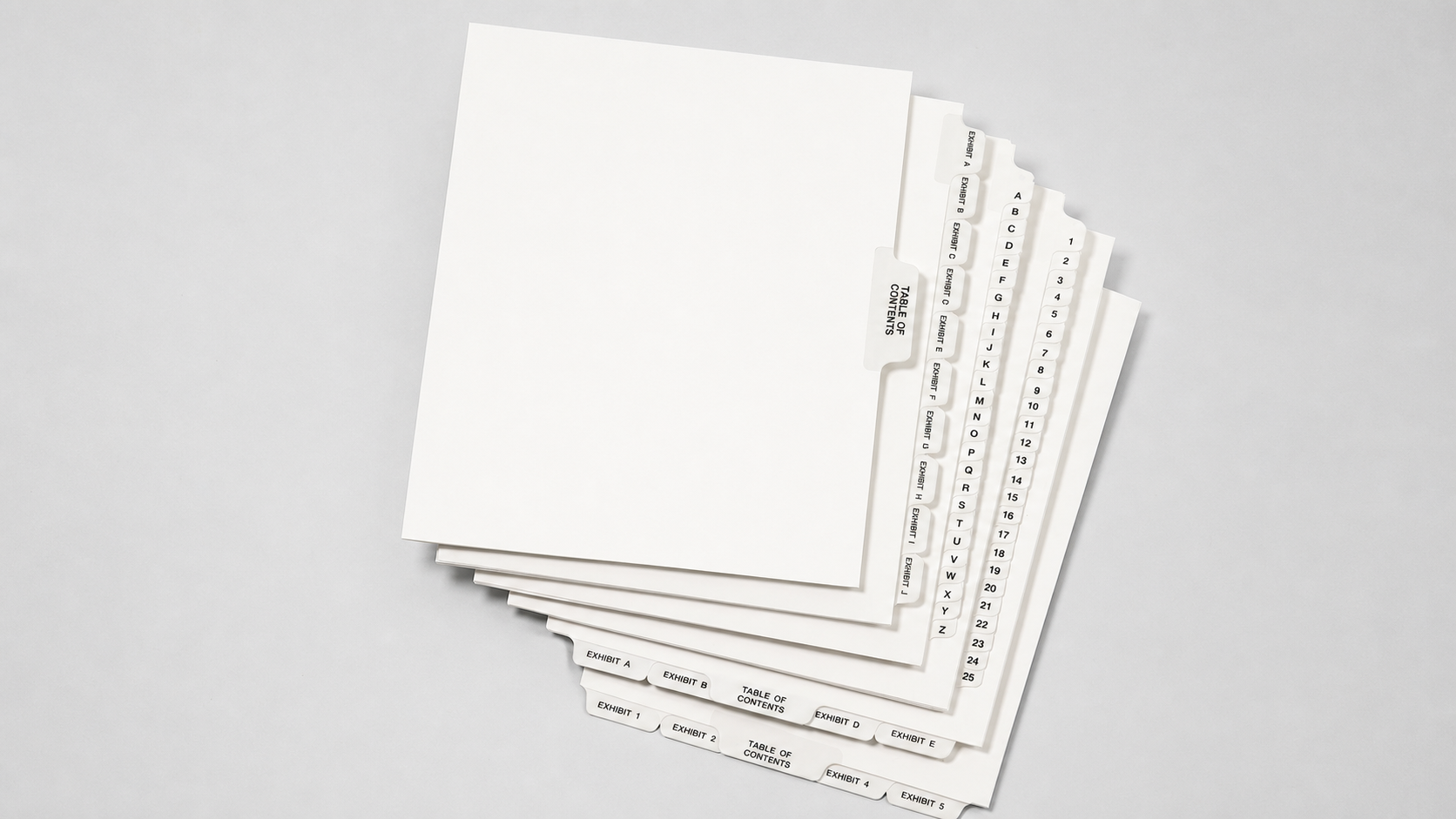
Law firms need exhibit tabs that make case files easier to navigate under pressure. For teams preparing materials in Dayton, Centerville, Cincinnati, Columbus, and elsewhere in Ohio, the right specification depends on the case, binder format, page count, and any instructions from the court or client.
Custom printed exhibit tabs and tabbed legal dividers can create a clear visual index for attorneys, paralegals, witnesses, and anyone reviewing a working copy. The goal is simple: make the next section easy to find without searching through an unmarked stack.
This guide covers the decisions to confirm before ordering legal exhibit dividers, including tab style, labeling, stock, punching, proofing, and assembly.
1. Understanding Exhibit Tab Types
Legal exhibits aren't one-size-fits-all. Depending on the size of the case and the specific requirements of the court, you’ll need a specific indexing strategy.
Numeric vs. Alphabetical Tabs
- Numeric Tabs: The standard for most civil and criminal trials. We produce sequences from 1–10, 1–500, or custom ranges to match your exhibit list.
- Alphabetical Tabs: Often used for smaller sets of exhibits or to distinguish defense exhibits (e.g., Exhibit A, B, C) from plaintiff exhibits (e.g., Exhibit 1, 2, 3).
- Custom Labels: We can print specific identifiers directly on the tab, such as "PX-1," "DX-A," "State’s Exhibit 5," or even witness names.
Side Tabs vs. Bottom Tabs
The orientation of your tabs is usually dictated by the format of the filing:
- Side Tabs (Right Edge): Ideal for trial binders and working copies. These allow users to flip through volumes quickly.
- Bottom Tabs (Bottom Edge): Frequently required for appellate records, briefs, and depositions where documents are read in a top-to-bottom flow.
2. Technical Specifications: Tab Cuts and Banks
The "cut" of a tab refers to how many tab positions fit along a single edge. Choosing the right cut ensures that your labels are readable and that your "banks" (groups of tabs) are logically organized.
- 1/5 Cut: Five tabs per bank. These are larger and offer the most room for text, making them perfect for major sections.
- 1/6 Cut: Six tabs per bank. A common middle ground for medium-sized exhibit sets.
- 1/10 Cut: Ten tabs per bank. These are narrower but allow you to see more exhibit numbers at a glance.
- 1/26 Cut: Specifically designed for alphabetical sets (A–Z). This ensures a full alphabet fits perfectly along the edge of a standard 11-inch sheet.
At Print Wave, we manage these complex configurations using advanced production techniques to ensure every set is collated perfectly before it leaves our shop.
3. Materials and Durability: Mylar and Paper Weight
Trial binders undergo significant wear and tear. If a tab rips during a cross-examination, it’s more than a nuisance: it’s a distraction.
Mylar Reinforcement
Mylar (a durable polyester film) is the industry standard for legal dividers. We offer two types of reinforcement:
- Tab Lamination: A clear or colored film bonded over the tab extension to prevent tearing.
- Edge Reinforcement: A strip of Mylar along the binding edge. This prevents the pages from pulling out of 3-ring binders, even with heavy use.
Choosing Your Paper Weight
We typically recommend 80 lb or 90 lb index stock for most legal applications. It provides the necessary stiffness to stand out from the document pages without adding unnecessary bulk to your binders. For high-frequency "judge’s copies," we can move up to 110 lb stock for maximum longevity. You can learn more about how these choices affect your project in our guide to materials and durability.
4. Custom Branding for Your Firm
While the primary goal of exhibit dividers is organization, they are also an opportunity to reinforce your firm's brand. We can incorporate your firm’s logo or specific case identifiers on the face of the divider sheets.
Custom printed legal exhibit tabs with a subtle logo in the corner convey a level of preparation and resources that generic tabs cannot match. It signals to the court and opposing counsel that every detail of the case has been handled with precision.
5. Court Instructions and Project Specifications
There is no single tab format that applies to every legal project. A judge’s standing order, filing instruction, client preference, or internal case convention may determine whether tabs are numbered or lettered, placed on the side or bottom edge, or grouped into separate banks.
Treat the court or client instruction as the source of truth. Before production, confirm the exhibit labels, sequence, page size, punching pattern, number of sets, and whether the project includes working copies, courtesy copies, or an electronic index. Print Wave can use that approved specification to prepare a quote and proof; the law firm remains responsible for confirming the legal requirement.
6. Planning for Confidentiality and Deadlines
Legal printing projects benefit from a written production plan. Share only the files needed for the approved scope, identify the deadline and destination, and ask how files, proofs, printed sets, and unused material will be handled. A clear handoff gives the print team enough information to identify missing pages or unclear labels before production.
Timing depends on page count, tab construction, quantity, finishing, proofing, shipping, and file completeness. Request a project-specific schedule that includes proof approval and delivery.
For a quote, include the case or project name, exhibit list, page size, tab position, number of sets, punching requirements, delivery locations, and desired in-hand date.
7. Local Ohio Support and Shipping Questions
Print Wave serves businesses in the Dayton and Centerville area, with Ohio firms in communities such as Cincinnati and Columbus also able to request project-specific production and delivery options. Pickup, delivery, and shipping depend on project size, destination, and deadline, so confirm those details when requesting a quote.
For a multi-office or out-of-state project, provide one approved specification sheet and a complete destination list. That gives the production team a clear reference for every set and makes it easier to catch differences before materials ship.
Conclusion: Partner with a Print Expert
Your focus should be on the law, not whether your exhibit tabs are in the right order. By choosing Print Wave as your legal print partner, you’re gaining an expert guide who understands the technical nuances of legal exhibit dividers.
From 1/26 cut alphabetical sets to Mylar-reinforced numeric banks, we provide the tools your litigation team needs to stay organized and authoritative in the courtroom.
Ready to start your next project? Contact us today for a clear scope and timeline on your custom legal exhibit tabs. We will document the approved scope and confirm production timing before the project begins.
Frequently Asked Questions
What information is needed to quote custom exhibit tabs?
Provide the tab labels in order, tab position, bank arrangement, sheet size, stock, reinforcement, punching, quantity of sets, binder requirements, proof contact, and deadline.
Can exhibit tabs use case-specific names instead of letters or numbers?
Yes. Custom labels can identify witnesses, motions, topics, dates, or other approved sections. Longer labels may require a wider tab or adjusted typography.
How much time should a firm allow for tabbed sets?
Timing depends on the number of labels, sets, pages, punching, reinforcement, assembly, proof revisions, and delivery plan. Request a confirmed schedule before relying on a completion date.