
July 26, 2026
Partial Wraps vs. Full Wraps: Which Commercial Vehicle Wrap Is Right for Your Fleet?
Choose a partial wrap when selective coverage meets the message and budget. Choose a full wrap when the design needs a larger, more unified visual canvas.
By Print Wave
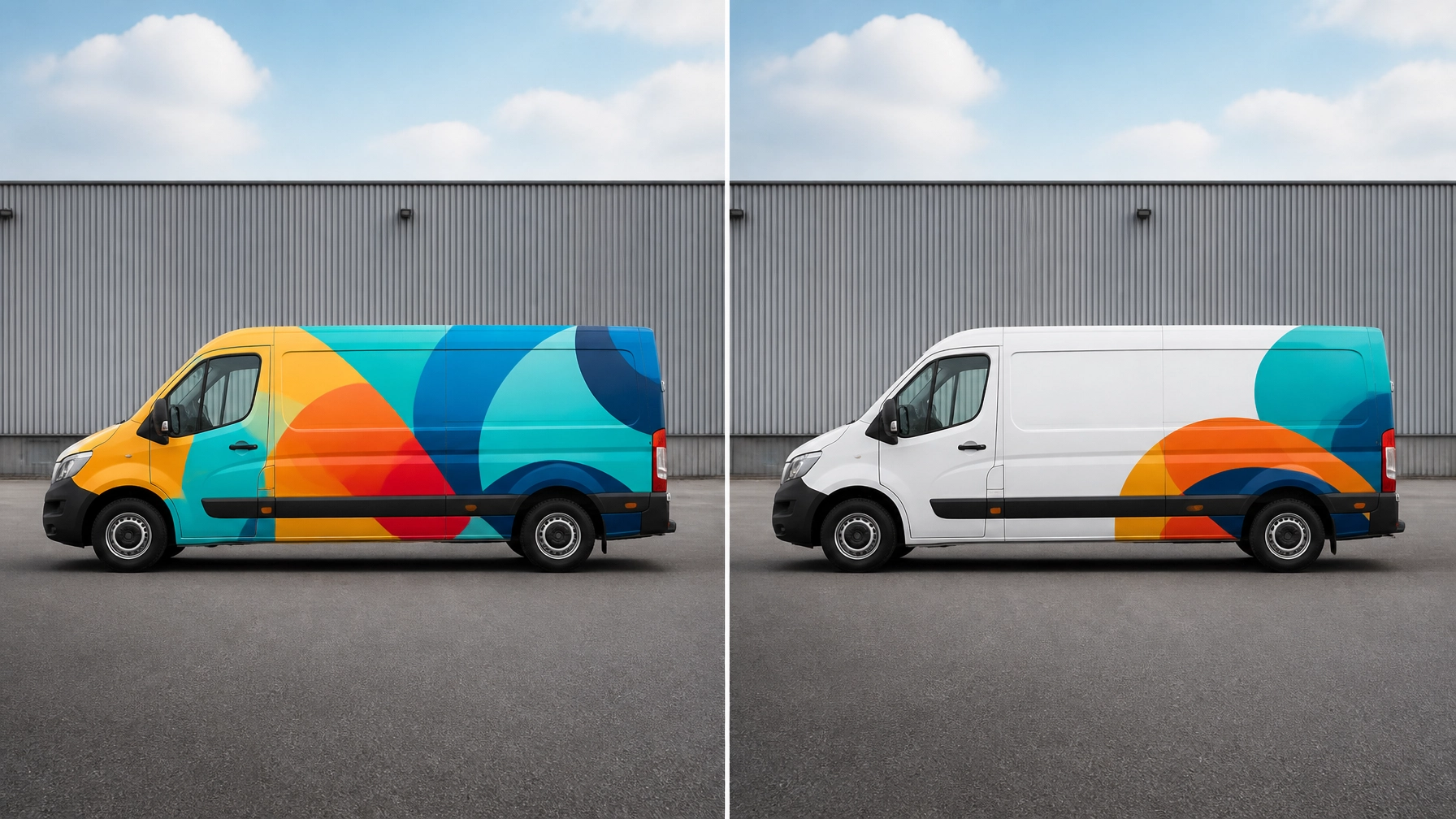
A partial wrap is usually the better fit when selected doors, rear panels, or body sections provide enough room for the message. A full wrap is useful when the design needs a larger, more unified visual canvas or must work around an inconvenient factory color. Neither option is automatically the better investment; the right choice depends on the vehicle, artwork, budget, operating schedule, and how the fleet will be used.
For Dayton-area service fleets, begin with the information a customer should remember after seeing the vehicle for only a few seconds. Then choose the least amount of coverage that communicates that message clearly.
What Counts as Truck Lettering, a Partial Wrap, or a Full Wrap?
Truck lettering typically uses cut vinyl for a company name, phone number, website, license number, or simple logo. It is a focused option when the vehicle already has a suitable base color and the message does not need a printed background.
A partial wrap uses printed vinyl across selected panels or portions of the vehicle. It can combine larger brand shapes, gradients, photographs, and lettering without changing most of the factory appearance.
A full wrap covers most of the practical painted body area defined in the quote. Coverage still varies. Roofs, bumpers, mirrors, handles, textured plastics, sensors, and trim should be confirmed instead of assumed.
When a Full Wrap Makes Sense
A full wrap gives the designer more freedom to create a unified look across the vehicle. It can be useful when:
- The factory color conflicts with the brand palette.
- The design needs large continuous graphics.
- Different vehicle colors need a more consistent fleet appearance.
- The vehicle is a prominent customer-facing brand asset.
- The campaign is expected to remain stable long enough to justify broader coverage.
Vinyl can also shield covered paint from some sunlight and light abrasion, but it is not a guarantee of perfect paint or resale value. Existing paint condition, prior repairs, installation quality, exposure, care, and removal all matter. Tell the installer about repainted panels, rust, peeling clear coat, or body damage before production.
When a Partial Wrap Makes Sense
A partial wrap can create a strong, professional result when the vehicle color becomes part of the design. It is often practical when:
- The budget must cover several vehicles.
- The main message fits on doors, rear quarters, or another clear panel group.
- Vehicles need to return to service with less installation work.
- Campaign details may change before the vehicle is retired.
- The fleet includes flat, open panels that support efficient layouts.
Less coverage does not mean less planning. A partial wrap needs deliberate transitions between printed areas and factory paint. Panel seams, handles, wheel arches, body lines, and door movement affect the composition.
Compare the Real Project Inputs
| Decision factor | Full wrap | Partial wrap |
|---|---|---|
| Visual canvas | Broad, unified coverage | Selected high-value panels |
| Factory color | Can reduce its visual role | Usually becomes part of the design |
| Material and install scope | Higher | Lower in many cases |
| Scheduling | More installation work | Often less installation work |
| Future message changes | Larger area may need revision | Individual sections may be easier to replace |
| Best fit | Immersive branding | Focused fleet identification and promotion |
Pricing cannot be reduced to a trustworthy universal range. Vehicle size, body style, surface condition, coverage, material, laminate, artwork, removal, and fleet quantity all change the quote. Compare written scopes that describe the same coverage and materials.
Design for Readability Before Coverage
Coverage does not fix a crowded message. A service vehicle normally needs:
- A recognizable business name or logo.
- One clear description of the primary service.
- One memorable contact path.
- Strong contrast against the vehicle and surrounding graphics.
- A hierarchy that works from the side and rear.
Photographs and long service lists can be effective while parked but difficult to process in traffic. Review the design at a small scale and from a distance. If the name and service disappear, adding more vinyl will not solve the communication problem.
Account for Ohio Exposure and Fleet Operations
Sunlight, road salt, washing, tree cover, storage, mileage, and panel orientation all affect vinyl. Material and laminate should be selected for the expected exposure, not from a generic lifespan promise. Review our materials and durability guide when planning the specification.
Fleet operations matter too. Confirm which vehicles can be released, when they can arrive clean, how long the approved installation is expected to take, and whether vehicles will rotate through the shop. For multiple makes and models, each body style needs an adapted layout rather than a stretched copy of one master file.
Build a Better Fleet-Wrap Quote Request
Provide:
- Vehicle year, make, model, color, and unit count.
- Current photos of every body style and any damaged or repaired areas.
- Logo and brand files, preferably in vector format.
- Desired coverage and examples of styles you prefer.
- Required phone, web, license, or regulatory information.
- Installation location and vehicle-availability windows.
- Target launch date and rollout order.
Print Wave can use those details to prepare a clear scope for vehicle wraps or a coordinated fleet graphics program from our Centerville production location.
Plan the Coverage Before You Commit
A useful wrap proposal should show what is included, what remains factory paint, how different vehicle models will be handled, and when each unit is expected to return to service. Request a vehicle-graphics quote with the fleet details and the message customers need to remember.
Frequently Asked Questions
Is a partial wrap the same as truck lettering?
Not necessarily. Truck lettering may use individual cut-vinyl names, numbers, and logos, while a partial wrap commonly combines larger printed graphics across selected panels.
Does a full wrap cover every exterior surface?
Coverage varies by design, vehicle, hardware, and quoted scope. Roofs, bumpers, mirrors, textured plastics, and difficult trim areas should be confirmed rather than assumed.
What should a fleet manager provide for a wrap quote?
Provide the vehicle year, make, model, photos, quantity, artwork, desired coverage, installation location, and scheduling constraints. That information makes coverage and downtime easier to plan.